The hardware arms race in PC gaming just hit a new level that’s got even seasoned enthusiasts doing double-takes at their rigs.
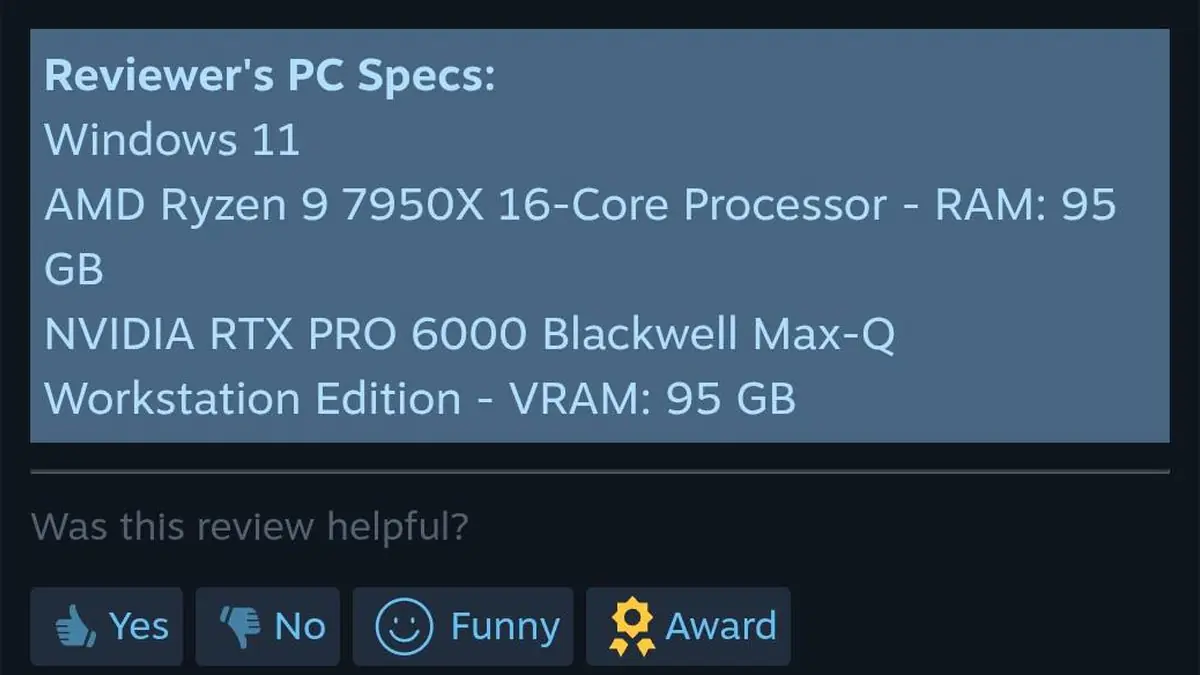
A Steam user’s recent post about spotting some absolutely wild system requirements has kicked off another round of the eternal PC gaming debate: how much is too much when it comes to hardware demands?
“Most insane specs I’ve seen on a review” — u/Warm-Cry-9732 on r/Steam
That simple statement hit a nerve with PC gamers who’ve been watching minimum requirements creep higher and higher over the past few years. We’re talking about specs that would have been considered high-end enthusiast territory just a couple generations ago becoming the baseline for getting games to even boot up.
The reality check is hitting hard for anyone still rocking older hardware. What used to be a solid mid-range gaming PC from 2022 might struggle to meet the minimum requirements for some 2026 releases. That’s a brutal upgrade cycle that’s pricing out a lot of gamers.
It’s not just about having the latest GPU anymore either. Modern games are demanding serious CPU power, tons of RAM, and fast storage. The days of getting by with 8GB of system memory are basically over if you want to play new releases without constant stuttering and loading screens that feel like eternity.
Some developers are pushing boundaries because they can. With more powerful consoles setting new baselines and PC hardware advancing rapidly, there’s less incentive to optimize for older systems. Why spend weeks optimizing when you can just tell people to upgrade their RAM?
But here’s where it gets interesting from a technical standpoint. These higher requirements aren’t always about better graphics. Modern games are doing way more complex calculations under the hood. Better AI, more detailed physics simulations, larger world sizes that need to be loaded and tracked simultaneously. All of that computational work adds up fast.
The storage requirements alone tell the story. Games that used to clock in at 20-30GB are now regularly hitting 100GB or more. That’s not just because textures got prettier (though they did). It’s because there’s simply more content, more audio tracks, more language packs, and less aggressive compression to avoid performance hits during gameplay.
From a value perspective, this creates a real problem for budget-conscious gamers. Building a system that can handle today’s demanding titles means spending serious money on components that might be overkill for older games in your library but necessary for anything releasing in the next year or two.
The recommendation specs are usually even more brutal than the minimums. Sure, you might be able to launch the game with the minimum requirements, but you’ll probably be stuck with low settings and choppy framerates. The recommended specs are often what you actually need for a decent experience at 1080p.
This whole situation highlights the growing gap between PC gaming and console gaming accessibility. Console players get a locked-in experience for several years without worrying about upgrades. PC players get better performance and more options, but they’re constantly evaluating whether their hardware can keep up.
The silver lining? Hardware prices have been coming down from their pandemic peaks, and you get more performance per dollar than ever before. A modern mid-range GPU absolutely demolishes what high-end cards could do five years ago. The problem is that games have scaled up their demands right alongside the improved hardware.
Looking ahead, this trend isn’t slowing down anytime soon. As game engines get more sophisticated and developers target newer console hardware as their baseline, PC system requirements will keep climbing. The next wave of games built specifically for current-gen consoles will likely push requirements even higher.
For anyone planning a build or upgrade, the smart move is probably to overshoot on specs rather than trying to hit the minimum requirements. Today’s overkill is tomorrow’s baseline, and that timeline keeps getting shorter. This thing absolutely rips when you future-proof properly, but it’s going to cost you upfront.