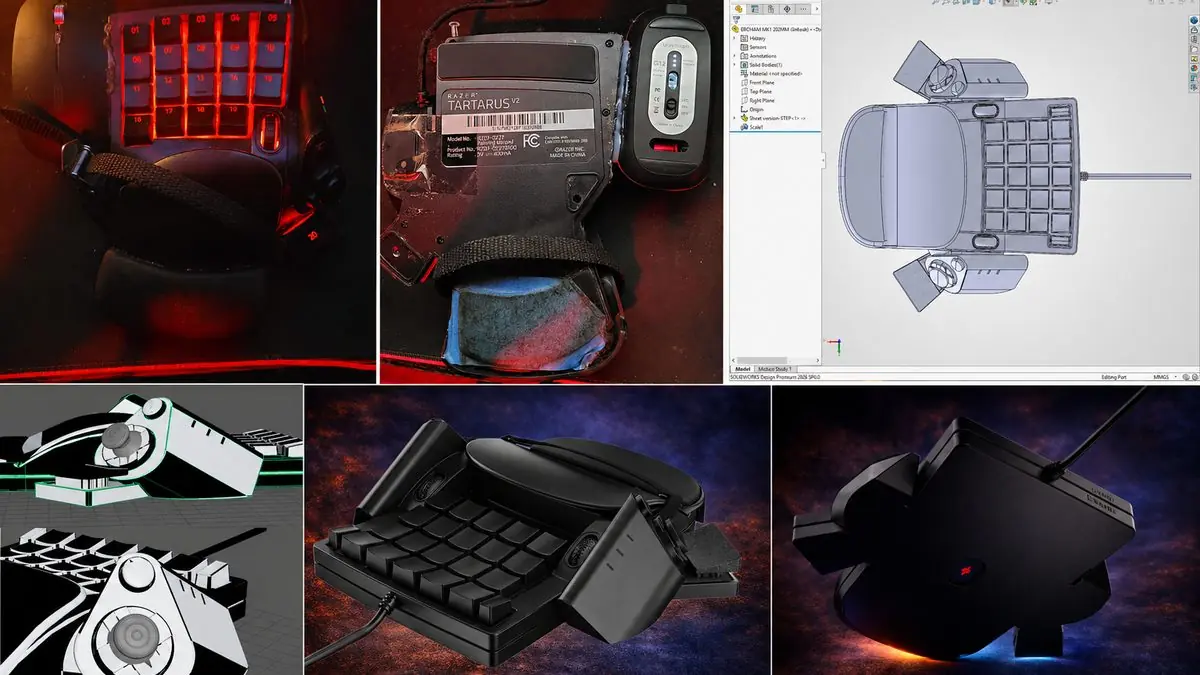
When Joe lost his right arm in an accident, most people would have assumed his gaming days were over. FPS games? Forget it. MMOs with complex hotkey rotations? Not happening. But Joe had other plans. Instead of giving up, he grabbed a Razer Tartarus gaming keypad, hot-glued a mouse to it, and started rebuilding his gaming setup from scratch.
What started as a desperate hack turned into something genuinely impressive. The proof of concept worked well enough that Joe decided to design a proper version – and the specs are actually pretty solid.
“After losing my right arm, I refused to quit gaming and designed my own one-handed controller” – u/Adventurous_Tie_9031 on r/gaming
The engineering here is surprisingly thoughtful. Joe’s final design integrates a mouse sensor directly into the controller body, eliminating the awkward hot-glue setup. He added a proper hand strap for stability and redesigned the button layout for ergonomic one-handed use. The key insight was remapping traditional WASD movement and mouse look to work entirely through the keypad and integrated sensor.
From a performance standpoint, this thing apparently handles FPS games without major compromises. Joe reports being able to play shooters, MMOs, and RPGs with decent speed and precision. That’s genuinely impressive when you consider the input complexity of modern games.
Of course, there are some obvious limitations. The learning curve is probably steep – retraining muscle memory for completely new input schemes takes time. The device likely works better for some game genres than others. Strategy games and turn-based RPGs would probably be easier to adapt than twitchy competitive shooters.
There’s also the question of availability and cost. This is currently a one-off prototype, not a commercial product. Joe would need manufacturing partners, regulatory approval, and significant funding to bring this to market. Specialized accessibility hardware tends to be expensive due to low volume production.
The broader accessibility angle here is what makes this actually important. Gaming hardware companies have made some progress on inclusive design, but options for one-handed play are still pretty limited. Microsoft‘s Xbox Adaptive Controller was a good start, but it requires additional expensive components and mainly targets console gaming.
Joe’s approach tackles PC gaming specifically, which opens up a huge library of titles that work better with keyboard and mouse input. The integrated design also means fewer separate components to manage – always a plus for accessibility gear.
The timing is interesting too. We’re seeing more attention on gaming accessibility across the industry. Sony added extensive accessibility options to recent PlayStation exclusives. Valve has been experimenting with customizable input schemes in Steam. Major publishers are starting to include more accessibility features in AAA releases.
But hardware innovation like this usually comes from individuals and small teams, not big companies. The major peripheral manufacturers could probably develop something similar, but the market size makes it tough to justify R&D investment.
What’s really impressive is Joe’s commitment to sharing the design. Rather than trying to patent and monetize everything, he’s focused on helping other disabled gamers. That community-first approach could lead to iterative improvements and variations for different types of physical limitations.
The next logical step would be open-sourcing the design files and component specifications. 3D printing and DIY electronics have made custom hardware more accessible than ever. With detailed plans, other makers could build their own versions or modify the design for specific needs.
Commercial production might happen eventually, but probably through a smaller company focused on accessibility hardware rather than a major gaming brand. The economics just work better at that scale.
For now, Joe’s prototype proves the concept works. One-handed gaming doesn’t have to mean giving up precision or complexity. With smart engineering and determination, the hardware can adapt to the player instead of forcing compromises.
That’s the kind of problem-solving that makes gaming better for everyone.