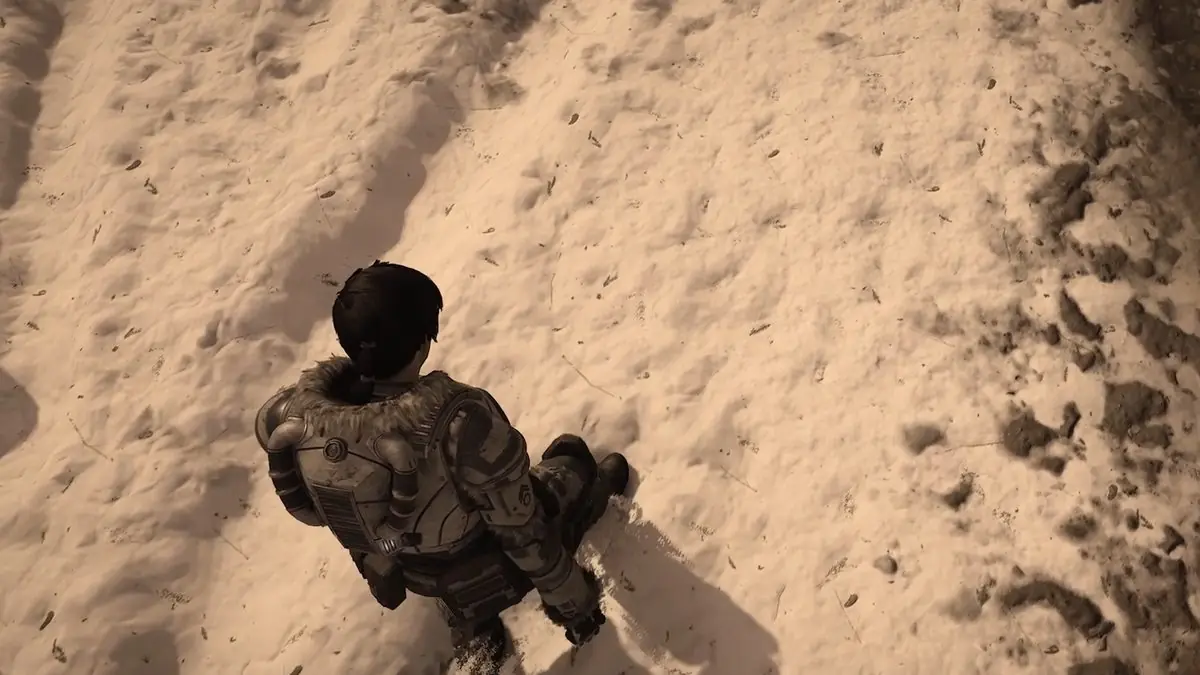
Picture this: you’re deep in the trenches of war, bullets screaming overhead, chainsaw bayonets revving in the distance. The fate of humanity hangs in the balance. And then you stop. Dead in your tracks. Not because of enemy fire or a sudden plot twist, but because the snow beneath your boots just did something beautiful.
This is the moment that captivated one Gears 5 player, who recently shared their awe on Reddit about something most gamers rush past without a second thought.
“Terrain deformation for surfaces such as snow or sand is, to me, a graphical marvel of video games. Watch as a 90’s kid puts the game on hold to be in awe over the snow texture depressing under my character’s feet and leaving tracks behind.” – u/Archmikem on r/gaming
There’s something almost sacred about these moments of discovery. When the chaos of combat gives way to quiet appreciation for the craft behind the carnage. The Coalition didn’t just build a war zone – they built a world that breathes, that yields, that remembers every step you take.
Terrain deformation isn’t new technology, but Gears 5 treats it like poetry. Every footstep in the snow tells a story. Every slide down a sand dune leaves evidence of your passage. In a franchise built on destruction and violence, these gentle impressions become unexpectedly profound.
The technical wizardry at play here runs deeper than surface-level eye candy. Creating convincing terrain deformation requires real-time physics calculations for every surface interaction. The game engine has to track particle displacement, calculate realistic settling patterns, and maintain visual consistency across different lighting conditions. Snow behaves differently than sand, which behaves differently than mud. Each surface demands its own physics ruleset.
But here’s what makes this moment special – it’s not about the technology itself. It’s about recognition. A player taking time to notice the artistry embedded in every line of code. Most games train us to look ahead, always moving toward the next objective, the next explosion, the next dramatic moment. Gears 5 rewards those who look down.
This speaks to something larger about how we experience games in 2026. We’ve reached a point where photorealistic graphics aren’t enough to impress us anymore. What moves us now are the details that feel human. The way snow compresses under weight exactly like we remember from childhood. The persistent reminder that someone, somewhere, cared enough to make this one small thing perfect.
The beauty of terrain deformation extends beyond visual fidelity into gameplay storytelling. Those footprints become breadcrumbs in stealth sections. Sand displacement reveals enemy movement patterns. Snow tracks tell the story of battles fought and territories crossed. The environment itself becomes a narrative tool, writing the story of your journey in real-time.
Gears 5 launched back in 2019, yet players are still discovering these moments of technical artistry years later. This longevity speaks to the difference between spectacle and substance. Flashy explosions grab immediate attention, but it’s the quiet perfection of snow physics that creates lasting memories.
The game industry often measures success in framerates and polygon counts, but moments like this remind us why details matter. Not because they push hardware to its limits, but because they push our capacity for wonder. They transform routine gameplay into unexpected meditation.
There’s also something beautifully meta about a self-proclaimed “90’s kid” pausing to appreciate modern graphics technology. It represents a full circle moment – from the blocky sprites of yesterday to the responsive snow of today. Each generation of gamers carries their own relationship with technological progress, their own baseline for what feels magical.
The Coalition understood something crucial: immersion isn’t built from grand gestures alone. It lives in the accumulation of small truths. Snow that behaves like snow. Sand that shifts like sand. Surfaces that respond to presence with the same quiet honesty as the real world.
As we look ahead to the next generation of gaming technology, terrain deformation will likely become even more sophisticated. We might see dynamic weather systems that change surface behavior in real-time, or AI-driven environmental storytelling that adapts based on player movement patterns.
But regardless of how advanced the technology becomes, the core appeal will remain the same – that moment of recognition when virtual worlds feel genuinely alive. When a player stops mid-mission not because they have to, but because something beautiful caught their eye.
So next time you’re stomping through a digital snowfield or sliding down virtual sand dunes, take a moment to look back at where you’ve been. Those footprints aren’t just proof of your passage – they’re evidence of artistry in motion, small miracles embedded in the code of our favorite worlds.