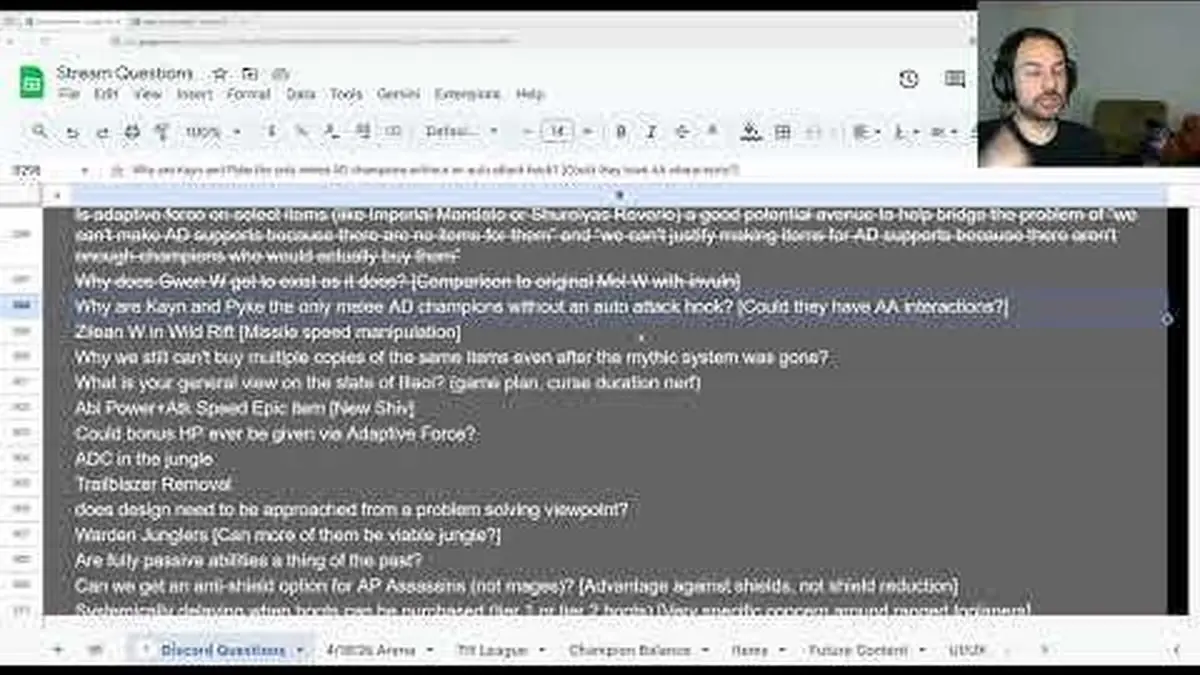
Sometimes the most interesting stories happen behind the scenes. When Riot developer Endstep sat down for a Discord Q&A session, he didn’t just talk numbers and balance changes. He pulled back the curtain on the narrative philosophy that shapes how League of Legends champions come to life, and why some features live in one version of the game but not another.
The conversation started with a question that gets to the heart of character design: why does Gwen get to keep her notorious W invulnerability when other champions like Mel had theirs removed? The answer isn’t just about game balance. It’s about who these characters are supposed to be.
Endstep explained that Gwen’s design philosophy centers around her being less mobile than other light fighters like Fiora or Ambessa. Where those champions can dash around the battlefield telling their own aggressive stories, Gwen’s narrative is different. She’s the doll brought to life who needs that protective bubble to survive in a world that wasn’t made for her. Her W ability isn’t just a gameplay mechanic – it’s part of her character’s story of finding safety in a dangerous world.
This kind of narrative-driven design thinking extends beyond individual abilities. Take the item system changes that removed players’ ability to buy multiple copies of the same item. While some players complained about losing tactical options, Endstep revealed the real problem wasn’t about restricting creativity. It was about storytelling clarity.
Most players didn’t understand how item passives stacked together. Named passives versus unique passives created confusion that broke the fantasy of building your character’s power. When players can’t intuitively understand how their choices affect their champion’s story, the whole experience falls apart. So Riot simplified the system, even hard-locking items with effects like Spellblade or Lifeline that don’t stack well together.
The most fascinating revelation involved the technical divide between League’s different versions. Wild Rift players get to experience Zilean’s missile speed manipulation – a feature that can slow enemy projectiles and speed up ally ones. It’s the kind of reality-bending power that perfectly fits Zilean’s time mage fantasy. But PC League players can’t have it yet.
The limitation isn’t about game balance or champion power levels. It’s purely technical. The visual effects system on PC League breaks down with older VFX when projectiles get manipulated. Riot decided not to invest the engineering resources needed to make it work across all the game’s visual elements. So Wild Rift gets this piece of Zilean’s story while PC players wait for the technology to catch up to the vision.
Then there’s Illaoi, whose design presents one of the most interesting narrative challenges in the game. She’s supposed to be a territorial control champion – someone who dominates her chosen ground but struggles when forced to fight elsewhere. That’s her story: the priestess who draws power from her sacred space.
But translating that fantasy into balanced gameplay creates problems. Make her too strong in her control zone and she becomes oppressive when she gets to choose the fight. Make her too weak outside it and she becomes irrelevant when forced to move. Endstep acknowledged this ongoing struggle to make Illaoi’s territorial fantasy work without breaking the game’s flow.
Even failed experiments tell stories about champion design philosophy. Endstep mentioned trying to create an AP and Attack Speed epic item – something that sounds perfect for hybrid champions who want to weave spells between auto attacks. But when they tested it, the item didn’t actually serve the champions it was designed for. The fantasy didn’t match the reality of how players actually wanted to build their characters.
These insights reveal how much thought goes into making each champion feel like a coherent character rather than just a collection of abilities. Every design decision has to serve both the gameplay balance and the champion’s narrative identity. When those two elements conflict, finding the right compromise becomes an art form.
The conversation also highlighted how platform limitations can fragment the League experience. Wild Rift isn’t just a mobile port – it’s becoming its own version of the game with features that PC League can’t support. That creates interesting questions about which version represents the “true” vision for champions like Zilean.
As League continues evolving across multiple platforms, expect more of these philosophical discussions about balancing champion fantasies with technical realities. The game’s future lies not just in adding new champions, but in refining how existing ones tell their stories through gameplay. Sometimes the most important updates happen in Discord Q&As, where developers can explain the human thinking behind the code.