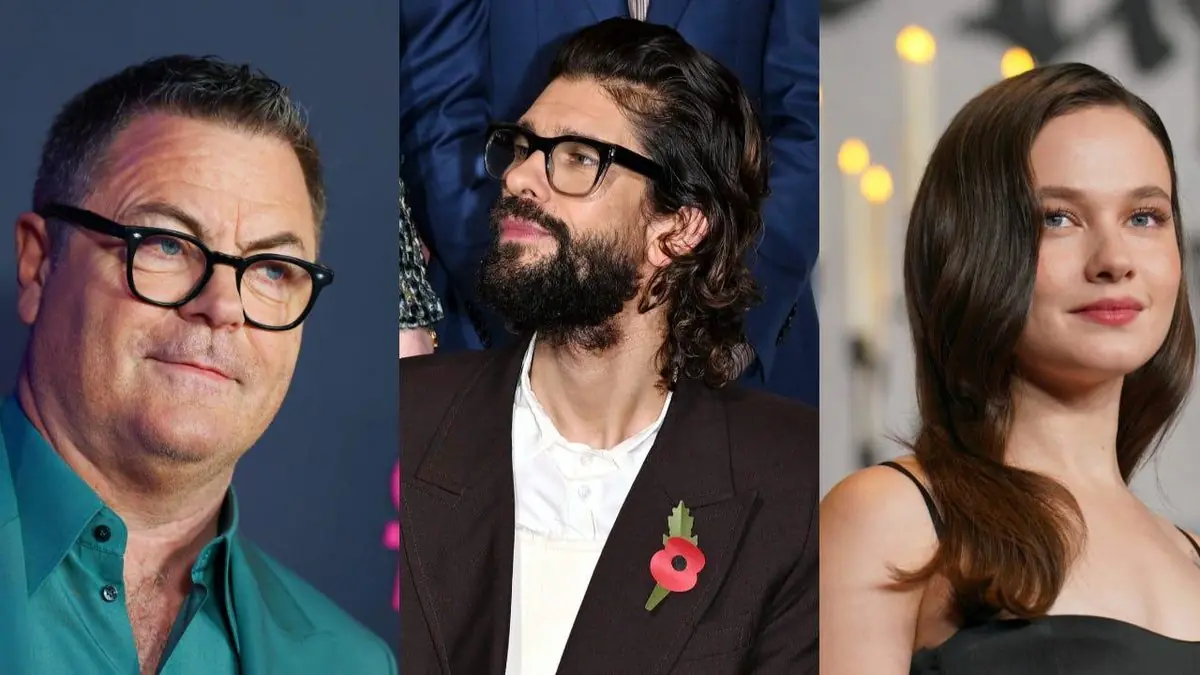
The fog lifts. The bells toll. And somewhere in the distance, Ron Swanson’s mustache twitches with the power of ancient runes.
The Elden Ring television adaptation just dropped its cast announcement like a meteorite crashing into Caelid, and the gaming world is reeling from the impact. Nick Offerman – yes, the woodworking legend himself – will lead an ensemble cast that reads like a fever dream spawned in the deepest reaches of FromSoftware‘s imagination.
Joining Offerman in this pilgrimage to the Lands Between are Ben Whishaw, fresh from his Bond villain days, and Cailee Spaeny, who proved she could handle apocalyptic chaos in Civil War. The show drops March 3, 2028, marking the first time a FromSoftware masterpiece gets the live-action treatment.
“Nick Offerman, Ben Whishaw, Cailee Spaeny, and More Confirmed for Elden Ring Cast – Releasing March 3, 2028” – r/gaming
The casting feels like finding a perfect weapon drop in your first playthrough. Offerman’s gravitas could anchor the philosophical weight that FromSoftware games carry like a bloodstained banner. Picture him as a grizzled Tarnished, delivering cryptic wisdom between brutal encounters with cosmic horrors. His deadpan delivery could make even the most obtuse NPC dialogue land with devastating impact.
Whishaw brings a different energy – one that could capture the haunting melancholy that seeps through every crumbling castle and forgotten catacomb. His ability to convey vulnerability wrapped in steel makes him perfect for a world where hope dies hard but refuses to stay buried.
Spaeny represents the new guard, the kind of performer who can believably swing a colossal sword while grappling with themes of ambition, corruption, and rebirth. Her recent work proves she can handle both intimate character moments and world-ending stakes.
But not everyone’s ready to praise the sun just yet. Adaptation anxiety runs deep in gaming communities, and Elden Ring fans know their beloved nightmare is notoriously difficult to translate. The game’s storytelling relies on environmental details, cryptic item descriptions, and the player’s own interpretation. How do you capture that mysterious, archeological approach to narrative in a traditional TV format?
Some worry about the violence getting sanitized for broader audiences. Elden Ring doesn’t pull punches – it’s a world where beauty and brutality dance together like lovers on the edge of madness. The source material demands an unflinching approach to its darker themes.
Others question whether any adaptation can match the personal triumph of overcoming seemingly impossible odds. The satisfaction of finally beating Margit after your twentieth attempt can’t be replicated by watching someone else’s journey.
Then there’s the practical concerns. Elden Ring’s visual spectacle costs serious money to recreate. Those sweeping vistas of the Lands Between, the intricate boss designs, the sheer scale of everything – it all adds up fast. Will the budget match the ambition?
Of course, the internet being the internet, memes started flowing faster than rune drops in Caelid. Jokes about Offerman crafting weapons in his garage workshop. Speculation about which boss fight will break Twitter when it airs. Bets on how many “git gud” references make it into the script.
The announcement timing feels perfect though. Gaming adaptations are having their moment. The Last of Us proved that video game stories can translate beautifully when handled with respect and understanding. Arcane showed that even game-adjacent narratives can find their own artistic voice while honoring the source.
This represents something bigger than just another adaptation. FromSoftware games have always been about more than gameplay mechanics. They’re digital mythology, exploring themes of decay, renewal, and the cyclical nature of power. They ask hard questions about ambition and sacrifice while wrapping those concepts in absolutely gorgeous, terrifying imagery.
Elden Ring specifically marked a watershed moment for the studio. George R.R. Martin’s involvement brought mainstream attention to Miyazaki’s vision. The game became a cultural phenomenon, spawning countless streams, guides, and discussions about its deeper meanings.
Now that mythology gets to expand beyond the interactive medium. The adaptation could introduce these themes to audiences who might never pick up a controller but hunger for complex, adult fantasy that doesn’t talk down to them.
The March 2028 release date gives the production team plenty of runway. That’s crucial for a project this ambitious. Rushing an Elden Ring adaptation would be like speed-running your first playthrough – technically possible but missing the entire point.
Expect more casting announcements as we get closer to production. The Lands Between contains multitudes of characters, from tragic demigods to mysterious merchants. Each role needs an actor who understands that in FromSoftware’s universe, everyone carries scars and secrets.
The real test will be whether the adaptation captures what makes Elden Ring special – that perfect balance of wonder and dread, beauty and horror, triumph and tragedy. If it succeeds, we might be looking at the beginning of a new golden age for gaming adaptations. If it fails, well, at least we’ll always have Nick Offerman swinging a greatsword.
March 3, 2028 can’t come fast enough. Time to start practicing our best Tarnished pose.