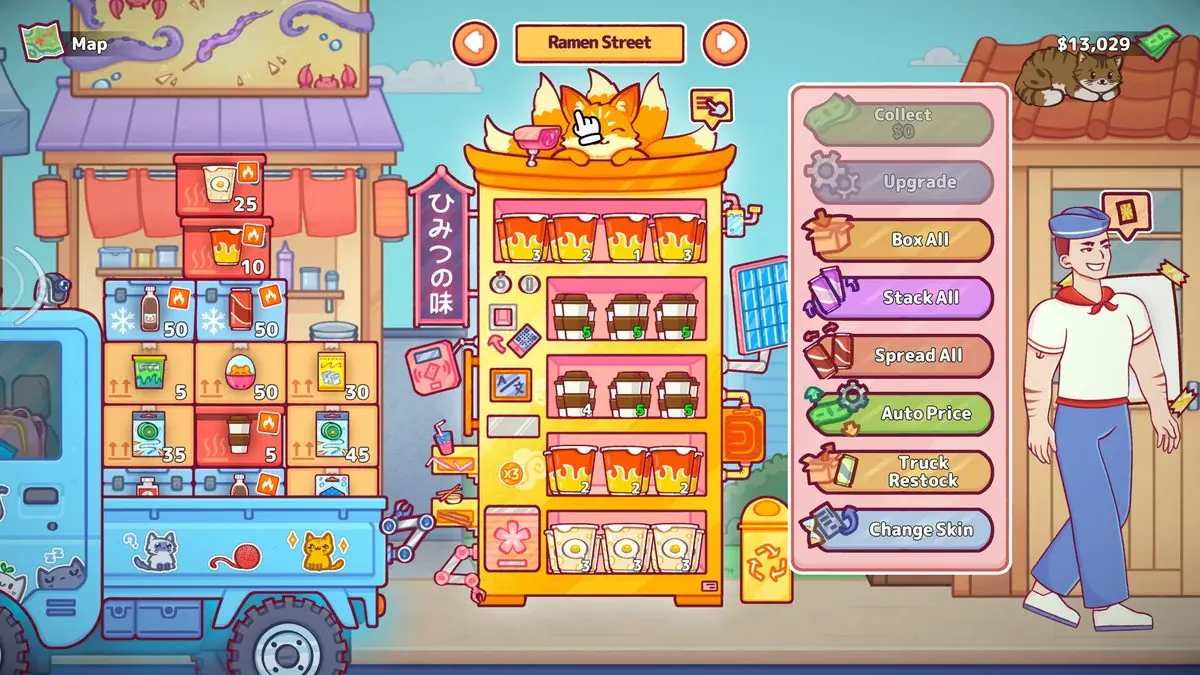
In the shadow of triple-A titans and battle royale behemoths, a quiet revolution brews. Not in the trenches of multiplayer warfare or the dungeons of fantasy epics, but in the humble corners where vending machines hum their mechanical lullabies. Today, that revolution has a name: Vending Machine Co.
Rogue Duck Team’s latest creation didn’t just launch on Steam. It conquered it. Like a perfectly executed combo in a fighting game, this Japanese-style vending simulator struck with precision that left even its creators stunned.
“This has been our biggest launch ever. Vending Machine Co. became our highest wishlisted release by far, nearly doubling our previous record. That honestly means the world to us.” – @Troypc
The numbers tell a story of unexpected triumph. Where most indie developers fight tooth and nail for every wishlist addition, Rogue Duck Team watched their simple concept about running vending machines capture imaginations on a scale they’d never seen. It’s the kind of success that reminds us why indie gaming remains the wild frontier of interactive entertainment.
But what transforms a basic business sim into a wishlist-shattering phenomenon? The answer lies in the details that separate artistry from assembly line production. Vending Machine Co. doesn’t just ask you to manage machines – it invites you to build an empire across a living, breathing Japanese cityscape.
The full version reads like a love letter to depth and player agency. Shift-click loading eliminates the tedium of dragging items. Truck upgrades include mysterious “illegal mods” lurking in the shadows of Yakuza Row. Temple charms offer daily bonuses that feel like sacred artifacts in this urban battlefield. Every system works together like instruments in a symphony, creating something greater than its parts.
Truck customization becomes a canvas for self-expression. Six base skins with six color combinations give every player their unique identity on the streets. It’s the difference between being another faceless vendor and becoming the legend whose truck people recognize from blocks away.
Perhaps most striking is Rogue Duck Team’s approach to additional content. In an era where DLC often feels like extortion disguised as expansion, their Supporter Pack stands as a monument to ethical development.
“We have an all-gamer team, and we don’t like full game content to be gated behind DLCs. Please don’t feel pressured to buy this pack; the full game itself has 6 skins and 6 different color combos for your truck. Supporter pack adds 10 more.” – @Troypc
This transparency cuts through industry noise like a katana through silk. No gameplay advantages hidden behind paywalls. No essential features carved out for profit. Just honest support for artists who poured their souls into hand-drawn artwork. It’s a philosophy that treats players as partners rather than prey.
The timing feels prophetic. As gaming giants stumble through controversy after controversy, indie developers like Rogue Duck Team remind us what this medium can be. They’ve created something that doesn’t need flashy graphics or celebrity endorsements to captivate audiences. Just pure, focused vision executed with surgical precision.
Meanwhile, in other corners of the gaming universe, established franchises continue their evolution. Crimson Desert rolled out patch 1.04.00, bringing new difficulty settings and inventory improvements that keep ambitious RPGs fresh for their dedicated communities.
“Crimson Desert Patch 1.04.00 is rolling out now on all platforms bringing in new game difficulty settings, new storage items, new pets, new category tabs for the inventory, distant scenery quality improvements, and much more” – @RPGSite
These parallel developments paint a picture of an industry where creativity flourishes at every scale. From intimate vending machine simulators to sprawling fantasy epics, developers continue pushing boundaries in their own unique ways.
What comes next for Rogue Duck Team feels like the opening chapter of a larger story. When your latest release shatters every previous record, the pressure to follow up can crush lesser studios. But their approach to Vending Machine Co. suggests a team that understands sustainable growth over flash-in-the-pan success.
The real victory isn’t just in the numbers. It’s in proving that originality still resonates in a market saturated with sequels and spiritual successors. Sometimes the most powerful weapon isn’t a legendary sword or futuristic rifle – it’s a simple idea executed with unwavering dedication to craft.
As players begin building their vending empires across those vibrant Japanese streets, they’re not just managing virtual businesses. They’re participating in a quiet revolution that reminds us why we fell in love with games in the first place. One perfectly stocked machine at a time.