Picture this: you’re Edward Kenway, standing on the deck of the Jackdaw with salt spray in your face and the Caribbean sun beating down. No health bars. No mini-maps. No glowing enemy markers breaking the spell. Just you, your cutlass, and the story unfolding through every gesture and movement around you.
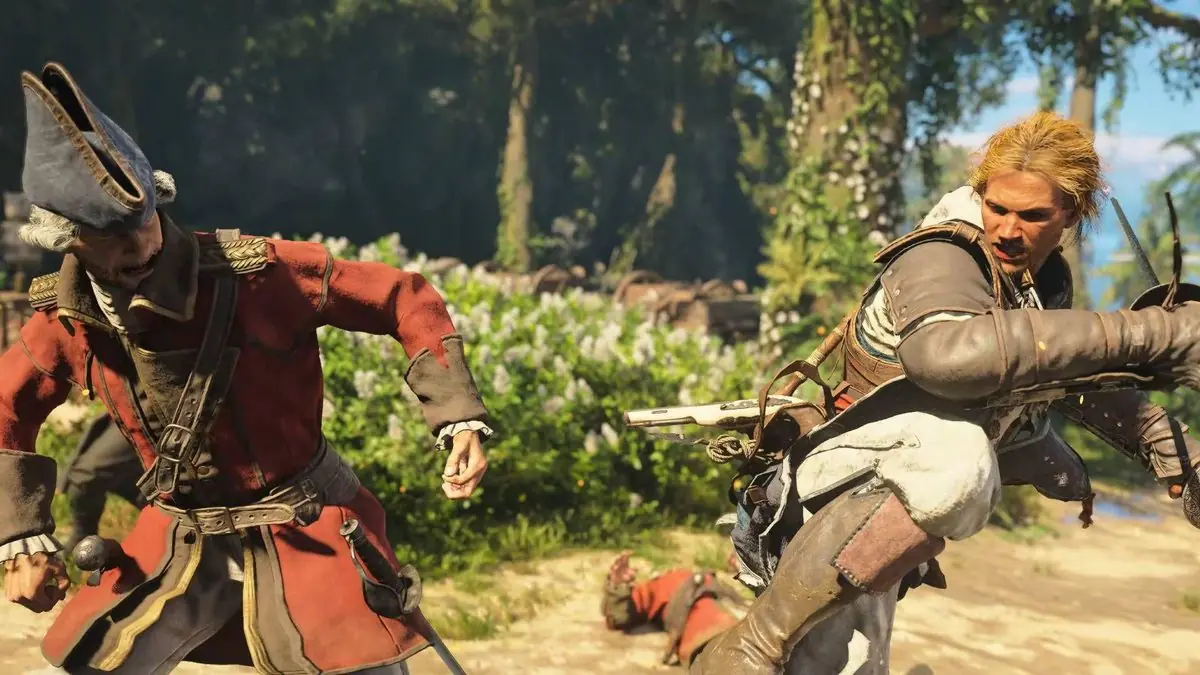
That’s the vision behind Assassin’s Creed Black Flag Resynced, where Ubisoft has done something remarkable. They’ve woven all the gameplay information directly into the fabric of the world itself. When you clash swords with a rival pirate and break through their defenses, you don’t see a status bar change. You watch their hat fly off their head.
“Assassin’s Creed Black Flag Resynced lets you turn off the HUD as Ubisoft baked all the information” – u/Sam_27142317 on r/PS5
It’s a small detail that speaks to something much larger. In a medium where we’re constantly told what to think and where to go through floating text and glowing waypoints, Black Flag Resynced trusts players to read the story in the characters themselves. That stumbling enemy isn’t just taking damage. They’re a person whose confidence just shattered along with their defense.
This approach transforms combat from a mechanical exchange into something that feels more like a scene from a swashbuckling film. Every clash of steel tells a story. Every defensive stance broken becomes a moment of character development, both for Edward and his opponents. The hat isn’t just a visual cue. It’s a symbol of dignity lost, of a fighter’s composure cracking under pressure.
The gaming community has been hungry for this kind of immersive design. Players have been modding HUD elements out of games for years, desperately trying to capture that feeling of being truly present in another world. What Ubisoft has done here is recognize that desire and build the solution directly into the experience.
But this isn’t just about removing clutter from the screen. It’s about trust between developer and player. It’s about believing that gamers are smart enough to understand visual language without having everything spelled out in text boxes and progress bars. When an enemy’s hat falls, experienced players will understand immediately what that means. New players will learn through observation and repetition, the same way we learn to read body language in real life.
The choice of Black Flag for this experiment makes perfect sense too. The game already excelled at environmental storytelling, with its living, breathing Caribbean world full of shanties, storms, and stories carved into every island. Adding HUD-free gameplay doesn’t just remove interface elements. It completes the fantasy of being a pirate in the golden age of piracy.
This kind of design philosophy could reshape how we think about game interfaces entirely. Imagine other historical settings where information flows naturally through the world. A medieval knight whose armor dents and scratches tell the story of battle. A Victorian detective whose posture changes as they piece together clues. These aren’t just gameplay mechanics. They’re narrative tools.
The implications stretch beyond just Assassin’s Creed too. As virtual and augmented reality become more prevalent, the lessons learned from projects like this become invaluable. In VR especially, traditional HUD elements can break immersion completely. Learning to embed information naturally into character animations and environmental details becomes essential for creating believable virtual worlds.
For storytelling in games, this represents a return to show-don’t-tell principles that have driven great narratives for centuries. Instead of telling players an enemy is weakened through a health bar, show them through a character’s movements, their expressions, their changing relationship with their equipment. The story becomes richer when it’s woven into every aspect of the experience.
Looking ahead, this could be just the beginning. If Black Flag Resynced proves popular, we might see other Ubisoft titles embrace similar design philosophies. The company has always been strong at world-building, but imagine that attention to detail applied to truly seamless storytelling where every animation serves both gameplay and narrative purposes.
The success of this feature could influence how other developers approach UI design too. We might see a new wave of games that prioritize immersion over convenience, trusting players to engage more deeply with the worlds they’re exploring. That’s a future worth getting excited about, where technology serves story instead of the other way around.