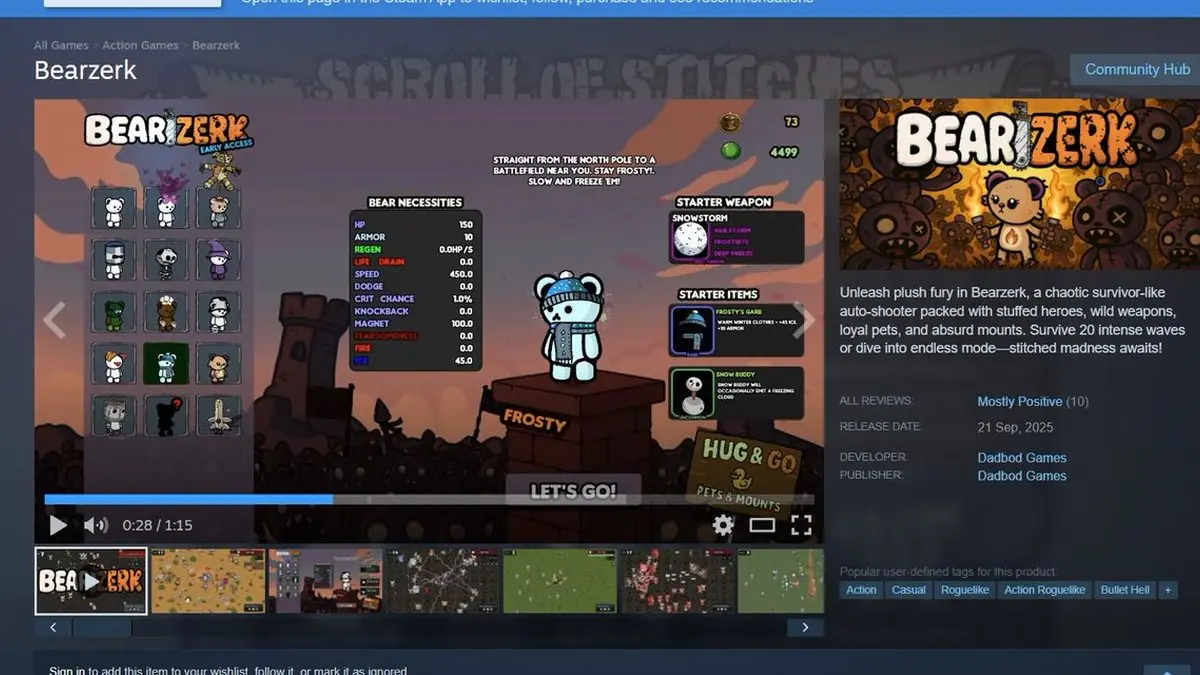
One review. Fifteen hours of gameplay. That’s all it took to change everything for indie developer Dadbod_Games and their overlooked title Bearzerk.
The developer dropped the news on Twitter yesterday, and it’s a perfect example of how brutal Steam‘s discovery system can be. Bearzerk launched last year to crickets. No fanfare. No viral moments. Just another indie game lost in the noise.
Then someone actually played it.
“I know most of what I post here is about my upcoming game I.T. Never Ends but I actually made and released my first game – Bearzerk – last year to relatively little fanfare. Yesterday, somebody was kind enough leave a review after playing the game for 15 hours, finally giving the game a ‘mostly positive’ rating on Steam and triggering the discovery queue. That was a nice little surprise :)” – @Dadbod_Games
Fifteen hours. That’s commitment. Most players bounce after the first hour if a game doesn’t grab them. This player stuck around. They saw something worth their time.
And that dedication just saved Bearzerk from digital obscurity.
Steam’s algorithm is merciless. It doesn’t care about your passion project or how many nights you stayed up coding. It wants data. Numbers. Reviews that prove players actually enjoyed your game.
Bearzerk needed that “mostly positive” threshold to unlock Steam’s discovery queue. One review made the difference between invisible and discoverable.
The harsh reality is most indie games never escape this trap. They launch with zero reviews. Players see zero reviews and keep scrolling. It’s a death spiral that kills promising games before they get a chance.
But here’s what separates the survivors from the casualties. Bearzerk earned that fifteen-hour commitment. The player didn’t just leave a positive review – they invested serious time. That suggests solid mechanics. Good design. Something worth sticking with.
Dadbod_Games isn’t a household name. They’re grinding in the trenches like thousands of other indie developers. Fighting for every player. Every review. Every moment of visibility.
The developer’s reaction says everything. Genuine surprise. Gratitude for a single review. No entitled demands for more coverage. Just appreciation for one player who took the time to recognize their work.
This is indie development in 2026. Brutal odds. Algorithmic gatekeepers. Success measured in individual player reviews rather than marketing budgets.
Steam’s discovery queue might seem like a small victory. It’s not. It’s the difference between your game existing and your game being found. Between obscurity and opportunity.
The timing works in Dadbod_Games’ favor too. They’ve got I.T. Never Ends in development. Bearzerk’s discovery queue inclusion creates momentum. Players who find and enjoy Bearzerk might follow the developer. They might wishlist the next project.
That’s how indie careers get built. One player at a time. One review at a time. One discovery queue inclusion at a time.
The lesson here cuts both ways. Players hold real power in the indie ecosystem. That review you’re thinking about writing matters. That extra hour you spend with a game that shows promise matters. Your engagement determines which developers survive and which fade away.
Developers need to earn those reviews though. Fifteen hours of engagement doesn’t happen by accident. Bearzerk clearly delivered something worth the player’s time and money.
The Steam marketplace rewards quality eventually. But only if players stick around long enough to recognize it. And only if they take thirty seconds to leave a review.
Bearzerk just proved that sometimes all it takes is one player who cares enough to speak up. One review that changes everything.
Dadbod_Games has earned their shot at discovery. Now they need to make it count. I.T. Never Ends represents their next opportunity to prove Bearzerk wasn’t a fluke.
The grind continues. But at least now they’re grinding with visibility.