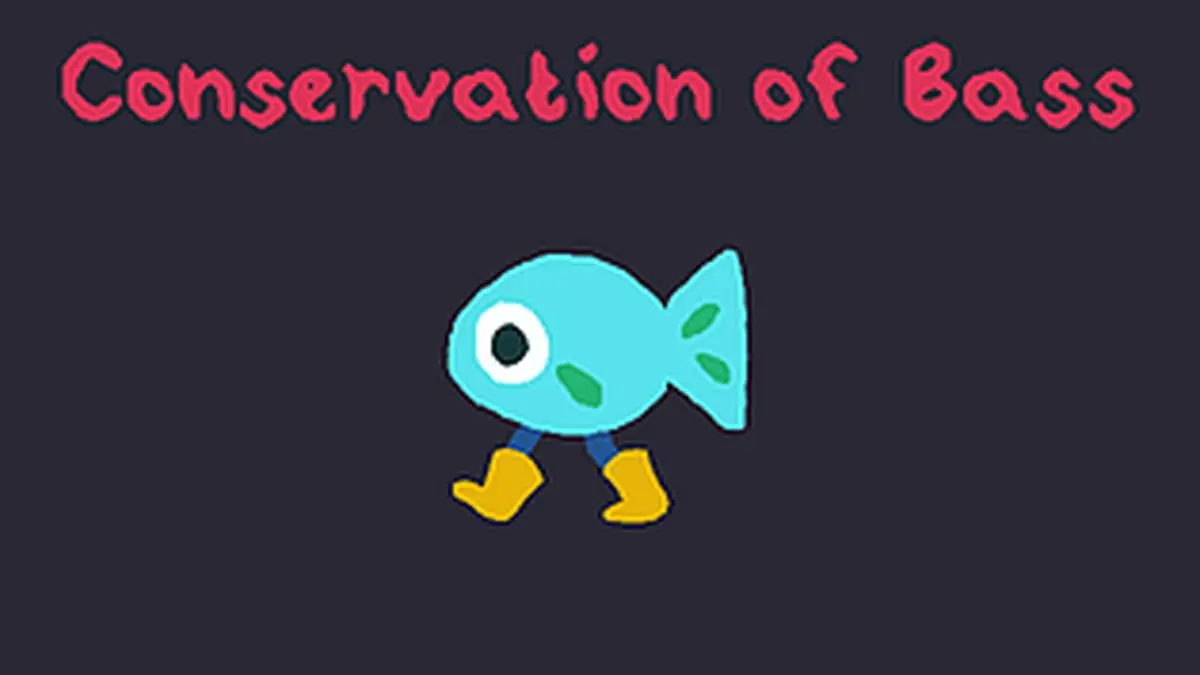
Physics just got a whole lot more fun. Imagine if Isaac Newton had access to a game engine and a quirky sense of humor – you’d probably get something like Conservation of Bass, a new indie game that’s making waves on itch.io. Developer emlise has crafted something that feels like a beautiful collision between a science textbook and a puzzle platformer.
The game takes its name from one of the fundamental laws of physics – conservation of mass – but don’t let that scare you away if you slept through chemistry class. This isn’t about memorizing formulas or solving equations. It’s about turning those abstract concepts into something you can actually play with, manipulate, and maybe even understand without breaking your brain.
“Bass cannot break the law of conservation of mass” – emlise.itch.io
That simple statement captures the entire premise. In a universe where everything from Star Trek’s replicators to Fullmetal Alchemist’s alchemy follows the same basic rule – matter can’t be created or destroyed, only rearranged – this game lets you experiment with those concepts in real time. Think Portal’s momentum puzzles, but instead of thinking with portals, you’re thinking with mass.
The timing couldn’t be better for a game like this. We’re living in an era where indie developers are pushing boundaries in ways that would make even the most creative sci-fi writers jealous. Itch.io has become the perfect breeding ground for these experimental projects – games that don’t need to sell millions of copies to justify their existence, just to spark curiosity and maybe teach us something new.
What makes Conservation of Bass particularly fascinating is how it tackles a concept that most people only encounter in stuffy classroom settings. Physics education has been crying out for this kind of interactive approach for decades. Remember trying to visualize conservation of momentum by watching your teacher drop balls? This is like that, but actually engaging.
The indie gaming scene has been gravitating toward educational content lately, and it’s not hard to see why. Games like Kerbal Space Program turned rocket science into rocket fun. Papers Please made bureaucracy compelling. Human Resource Machine taught programming concepts through puzzle mechanics. Conservation of Bass feels like the next step in that evolution – taking pure physics and making it playable.
This trend toward educational gaming isn’t just about making learning fun, though that’s definitely part of it. It’s about recognizing that games are incredibly powerful tools for understanding complex systems. When you can manipulate variables in real time and see immediate results, abstract concepts suddenly become concrete. It’s like having a physics lab in your pocket, minus the risk of accidentally creating a small black hole.
The choice to release on itch.io is smart too. The platform has become the go-to destination for experimental games that might not find a home on larger storefronts. It’s where developers can take risks, try weird ideas, and build communities around niche concepts. Conservation of Bass fits perfectly into that ecosystem – it’s the kind of game that doesn’t need massive marketing budgets or AAA production values to find its audience.
For sci-fi fans, there’s something deeply satisfying about a game that respects the fundamental laws of physics. Too many sci-fi universes hand-wave away conservation of mass with technobabble about “exotic matter” or “quantum flux generators.” Here’s a game that says no, these rules matter, and working within them can be just as creative and fun as breaking them.
The educational potential is huge. Imagine physics teachers using this as a supplement to traditional coursework. Students could actually play with conservation of mass instead of just reading about it. It’s the kind of interactive learning that science fiction has been promising us for decades, finally becoming reality through indie game development.
Looking ahead, Conservation of Bass could be the start of something bigger. We might be seeing the birth of a new subgenre – physics sandbox games that prioritize accuracy over flashy effects. If this catches on, we could see games exploring everything from thermodynamics to quantum mechanics, each finding creative ways to make abstract concepts tangible.
The indie scene has always been about innovation, but games like this push that innovation in directions that benefit everyone. When developers use their creativity to make education more engaging, they’re not just making games – they’re potentially changing how we learn about the universe around us.
Conservation of Bass is available now on itch.io, and honestly, it’s worth checking out just to see what happens when physics meets playful game design. In a world full of games that bend or break the laws of science, there’s something refreshing about one that embraces them instead.