The GTA 6 hype machine has claimed another victim — this time, it’s gaming journalism itself.
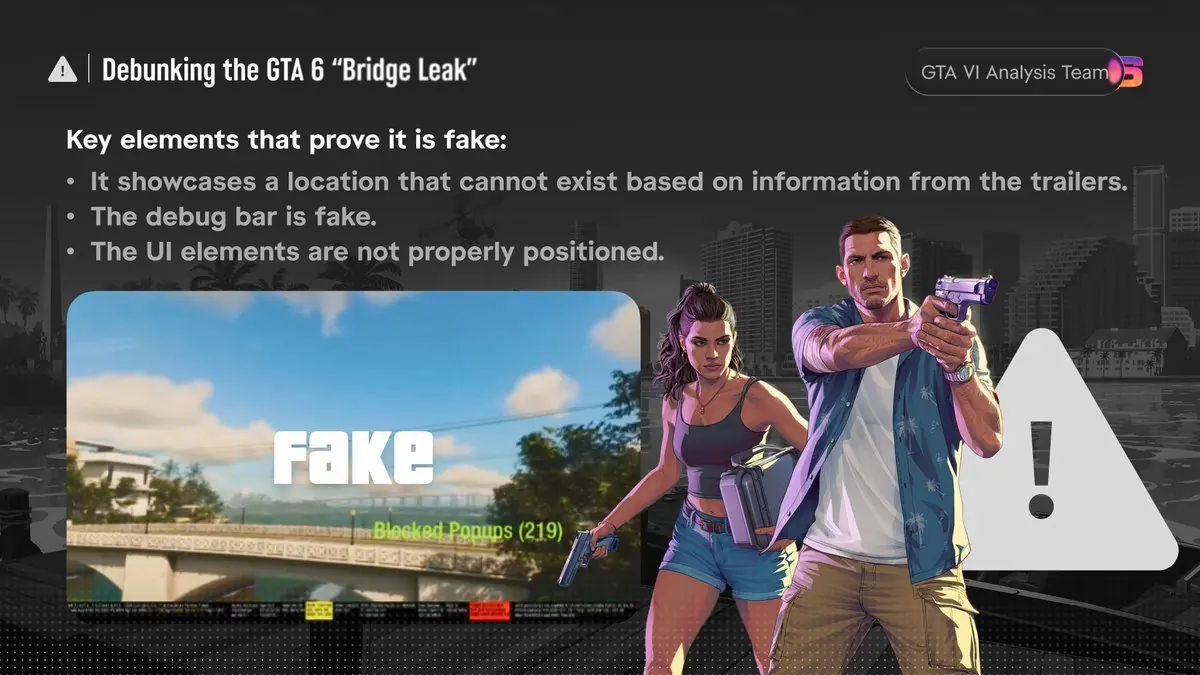
A fabricated leak dubbed the “GTA 6 Bridge Leak” is making rounds across the internet, and notably, multiple gaming sites are treating the bogus content as legitimate news. The situation perfectly captures how desperation for any morsel of GTA 6 information has created a perfect storm for misinformation to flourish.
The gaming community’s self-appointed watchdogs are sounding the alarm. Industry analyst @vianalysis took to Twitter to issue a stark warning about the spreading falsehood:
“Be aware of a fake GTA 6 leak that is spreading around the internet, known as the ‘GTA 6 Bridge Leak,’ and being suggested as legitimate across multiple gaming sites.” — @vianalysis
The warning has gained traction with over 300 likes and dozens of retweets, suggesting the community recognizes the severity of the misinformation problem. Meanwhile, the very existence of such warnings highlights a troubling reality: the line between legitimate reporting and rumor-mongering has become increasingly blurred.
What makes this situation particularly concerning is how gaming outlets — publications that should serve as gatekeepers of accurate information — are apparently falling for the ruse. The “Bridge Leak” appears to have been crafted specifically to exploit the current information vacuum surrounding Rockstar’s highly anticipated sequel.
This isn’t simply about one fake leak. The GTA 6 coverage landscape has become a minefield of questionable content, with every supposed “insider” claiming to have exclusive knowledge about the game’s development. The intense public interest has created perverse incentives where clicks matter more than verification.
Historically, Rockstar Games operates with military-grade secrecy around their projects. The studio’s track record shows they reveal information on their own terms, through carefully orchestrated marketing campaigns. Any “leak” that doesn’t align with this pattern should immediately raise red flags for discerning outlets.
Notably, the gaming journalism industry has struggled with verification standards for years. The rush to be first with breaking news often trumps the due diligence required to separate authentic information from elaborate hoaxes. Social media has accelerated this problem, creating echo chambers where false information can gain legitimacy through repetition rather than verification.
The “Bridge Leak” phenomenon also reveals something deeper about fan psychology. The six-year wait since GTA 5’s release has created an almost pathological hunger for any new information. This desperation makes audiences more susceptible to believing dubious claims, while simultaneously pressuring outlets to cover increasingly questionable “leaks.”
Meanwhile, the real winners in this misinformation game are often bad actors seeking to drive traffic to their platforms or social media accounts. By crafting convincing fake leaks, they can generate massive engagement and potentially monetize the resulting attention through ad revenue or follower growth.
The broader gaming industry should take note of this situation. As development cycles grow longer and fan anticipation reaches fever pitch, the incentive structure around leak culture becomes increasingly toxic. Publishers might need to consider more transparent communication strategies to combat the misinformation ecosystem that thrives in information vacuums.
For gaming outlets, this incident serves as a wake-up call about editorial standards. The rush to cover every possible leak has created an environment where verification takes a backseat to speed. Establishing clearer protocols for vetting unconfirmed information could help restore credibility to gaming journalism.
The “Bridge Leak” also demonstrates how community-driven fact-checking has become essential. When traditional gatekeepers fail, informed community members like @vianalysis step in to provide crucial corrections. This grassroots verification network represents both a failure of institutional journalism and a silver lining in the fight against misinformation.
Looking ahead, expect this pattern to continue until Rockstar provides substantial official updates about GTA 6. The studio’s silence, while strategically sound from a marketing perspective, has created fertile ground for exactly this type of misinformation campaign.
The gaming community would be well-served by approaching all unofficial GTA 6 information with healthy skepticism. Until Rockstar speaks, everything else should be treated as speculation at best and outright fabrication at worst. Meanwhile, gaming outlets need to rediscover the lost art of saying “we don’t know” instead of amplifying every questionable claim that crosses their desks.
The “Bridge Leak” incident won’t be the last of its kind, but it might serve as a turning point for how the industry handles unverified information in our increasingly connected world.