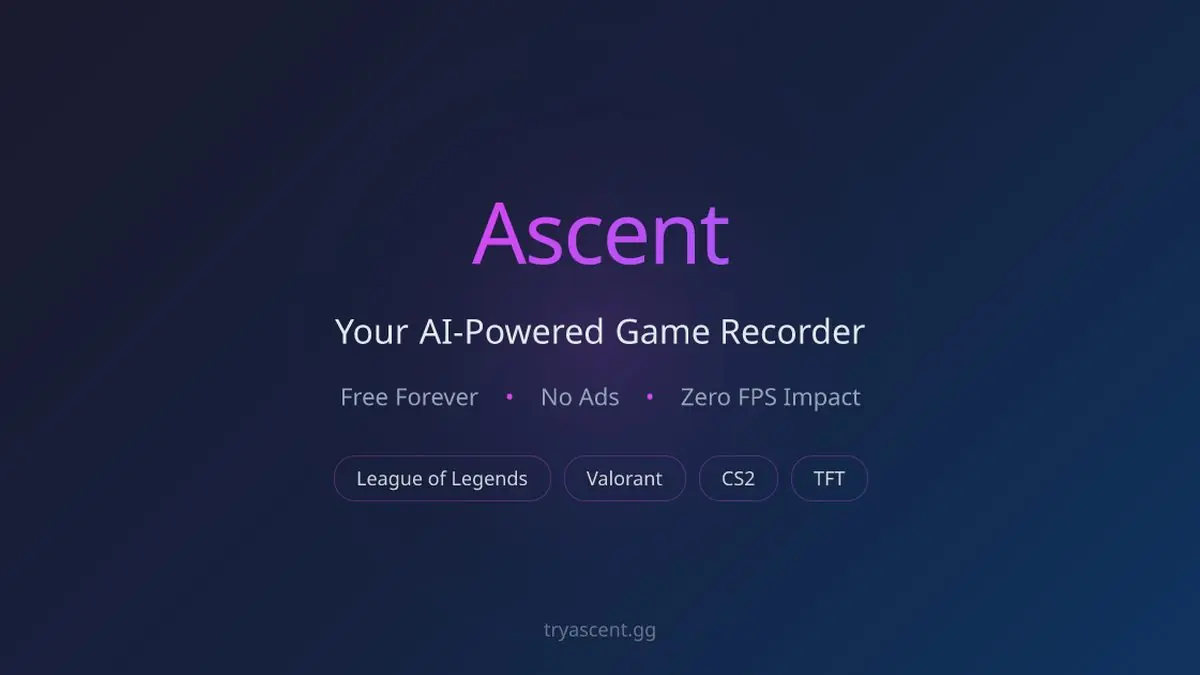
We’ve all been there. You pull off an insane play in League, your heart’s racing, and you want to share that clutch Baron steal or perfect team fight combo. But when you go to record it, your FPS tanks or you’re stuck dealing with clunky software that feels like it’s working against you. That’s exactly why a homegrown recording tool called Ascent is making waves in our community.
The developer behind Ascent just dropped some big news that’s got League players excited. After a full year of grinding away at improvements, the tool has officially hit 40,000 users. That’s not just a number — it’s proof that we’re hungry for better ways to capture and share our gameplay.
“[UPDATE] I made an automatic recorder that doesn’t use Overwolf. Hi everyone, a year ago I posted about our recorder called Ascent that automatically records your League games to allow sharing/clipping. Since then we’ve continued developing it and we’ve hit over 40k users and polished the app a ton.” — u/jpit10 on r/leagueoflegends
What’s really catching people’s attention isn’t just the milestone — it’s how Ascent got there. The tool promises near-zero FPS impact, which is huge for those of us who can’t afford to lose even a single frame during ranked games. Plus, there’s no Overwolf dependency, which has been a major pain point for many League players who’ve struggled with that platform’s performance issues.
The timing feels perfect too. We’re seeing more content creators emerge from the League community, and everyone wants to share their best plays. Whether it’s a solo queue highlight or scrimmage footage for team analysis, having reliable recording software that doesn’t hurt your game performance is essential.
Of course, any new tool in the League ecosystem raises some questions. We’ve all been burned before by software that promises the world but delivers crashes and compatibility issues. Some players might wonder about the long-term stability of a smaller developer compared to established recording solutions. Others could be concerned about potential security risks or whether the tool might trigger any anti-cheat systems.
There’s also the question of feature parity. While Ascent focuses on League specifically, some players use recording tools across multiple games. The trade-off between specialized League optimization and broader game support is something each player has to weigh for themselves.
The skepticism isn’t unfounded either. We’ve seen plenty of League tools come and go over the years. Remember when everyone was hyped about various replay systems that eventually got abandoned? The key difference here seems to be the developer’s commitment to continuous improvement rather than a quick cash grab.
But let’s zoom out and look at what this really means for our community. Ascent hitting 40K users isn’t just about one tool succeeding — it’s about us taking control of our gaming experience. We’re not just passive consumers anymore. We’re actively seeking out solutions that work better for our needs.
The fact that a solo developer can build something that resonates with tens of thousands of League players shows how much innovation can happen when someone actually understands our pain points. This isn’t corporate software built by people who’ve never experienced the frustration of missed recordings or FPS drops during crucial moments.
We’re also seeing this happen at a time when League content creation is exploding. From TikTok highlights to YouTube guides, more players are sharing their gameplay than ever before. Tools like Ascent lower the barrier to entry, making it easier for average players to create and share content without needing expensive streaming setups.
The detailed searching feature is particularly smart. Instead of scrolling through hours of footage, players can quickly find specific moments or plays. That’s the kind of quality-of-life improvement that shows the developer actually plays the game and understands what we need.
Looking ahead, the big question is whether Ascent can maintain this momentum. Reaching 40K users is impressive, but keeping them engaged and continuing to improve the software will be the real test. The developer mentioned ongoing development, which is encouraging.
We might see other developers take notice and either compete directly or improve their existing tools. Competition usually benefits us as players, so this could push the entire League recording ecosystem forward.
For now, it’s worth checking out if you’re tired of dealing with performance issues or invasive software. The fact that it’s built specifically for League by someone who clearly understands our needs makes it worth a shot. Whether you’re trying to improve your gameplay through replay analysis or just want to share those epic moments with friends, tools like this are exactly what our community needs more of.