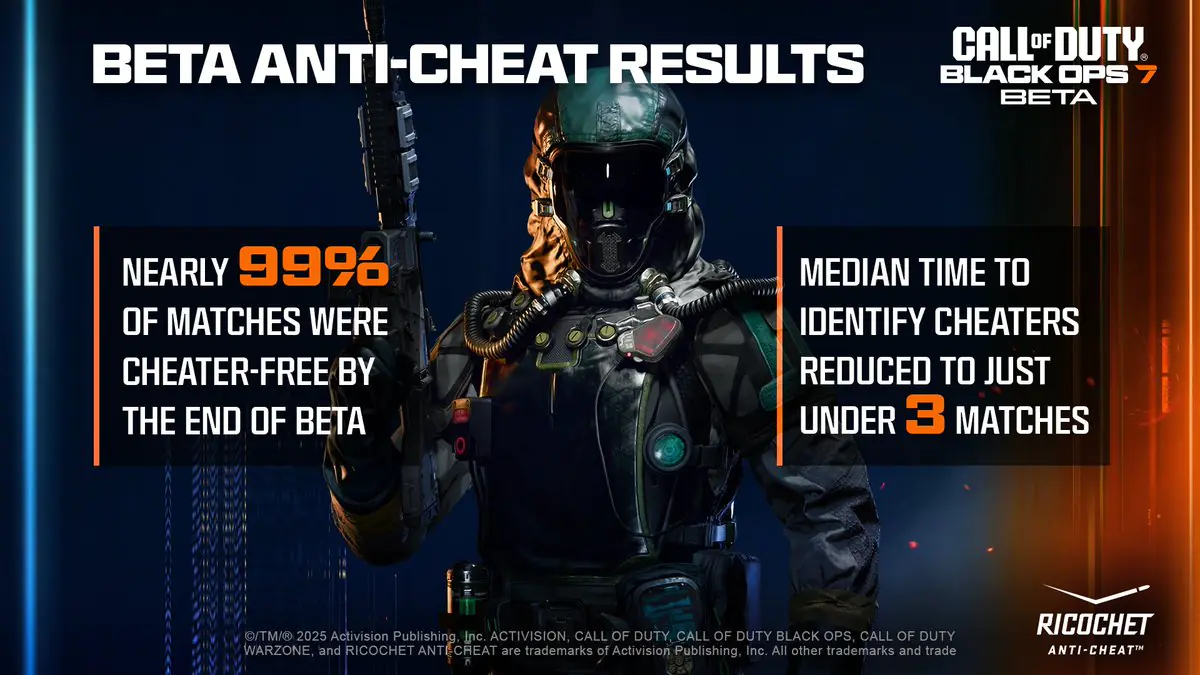
Activision just published some mind-boggling numbers about the RICOCHET Anti-Cheat system during the Black Ops 7 beta. The company claims to have reached the highest beta results in the history of Call of Duty, reporting that at the end of the test period 99% of games had no cheaters. That is an enormous claim for a series that has been fighting scalpels by the cheating issue, and the gamers’ community responses have been… complicated, to put it mildly.
So, what is RICOCHET Anti-Cheat after all? It is the proprietary Activision system that has gone through development from the killer titles of the past years and employs a combination of server-side and kernel-level drivers for detection and prevention of cheating. The kernel-level is basically part of the system and that has caused controversy over the years, but it is very effective apparently judging by the latest figures. The system can identify everything from aimbots to wallhacks and even the use of Cronus Zen devices that give players unfair advantages.
Of course, the community has had many different reactions and that is pretty much the typical scenario for the Call of Duty players. Some people are absolutely thrilled by what they experienced during the beta. A user named Christoffer told the story of how he actually ran into a cheater during the game, reported him, and then saw the account getting banned in 1-2 minutes. That’s pretty fast action that makes one think the system could actually be working as it should. It was like the “Donkey Kong” of the player world who claimed to have seen 4-5 cheaters during his 80 matches but at the same time conceded that Activision was fast moving to eliminate them.
On the other hand, there are plenty of skeptics who are indeed in a great number. Frostbytez0 believably called the announcement a hoax and insisted that people were streaming their cheating on TikTok throughout the whole beta time. Cheggleberry also added with a similar complaint saying they encountered about four cheaters during their beta experience and saw more than twenty online. Abraham Martinez responded with laughing emojis and pure disbelief while psykotoday hypothesized that the low cheating numbers could be due to the fact “nobody is playing this garbage!”
The ongoing discussion regarding cheating instantly brings Warzone into the picture when talking about multiplayer. Several players commented that the cheating issue is much worse in the free-to-play Warzone modes as cheaters are able to just create new accounts after getting banned. JonahAngell noted that when they played on PC, getting banned just meant making a new account in under five minutes and going back to Warzone. This single point illustrates the very core of the entire argument about the problems with cheaters in paid multiplayer versus those in free battle-royale modes.
Another thing that can’t be removed from the discussion is the whole Cronus Zen and similar devices situation. This cheating method that is hardware-based has been the biggest nightmare for the Call of Duty community as it provides players with things like less recoil and faster fire without being detected as traditional software cheats. The comments seem to hint that players are wondering whether RICOCHET is really catching these hardware cheaters or just ignoring them by focusing on software.
On top of that, it appears that the player experiences are quite divergent. Some people such as Dexide report that they have never seen any cheaters in the Call of Duty games while others feel that they are meeting them all the time. This variation in experience could be because of skill-based matchmaking which puts higher-skilled players in lobbies where cheating is more common, or simply that the cheating population is different in various regions.
The timing of this announcement is also a very smart move. With the launch of Black Ops 7 just round the corner, Activision clearly wants to give players the guarantee that they are taking the cheating problem very seriously. After all the years of being blamed for hackers ruining matches, they now have to persuade the community that it will be different this time around. The claim of 99% cheater-free is a bold one that creates high expectations for the release of the complete game.
One of the issues brought up by many players is that the cheat providers apparently had a hard time during the Black Ops 7 beta. There was one report stating that the distributors of cheats on Telegram channels were having difficulty in getting their software to work and some had not even come back online yet. This indicates that RICOCHET’s kernel-level approach can potentially disrupt the cheat development cycle in a way that previous anti-cheat systems have not been able to do.
Still, the question that everyone is most curious about is: will this beta success happen with the full game too? Generally, beta tests involve fewer players and the monitoring is much stricter, thus the real challenge will be to maintain the 99% cheater-free rate when millions of players come in at once at the launch. As one user noted, Activision might have to release more targeted statistics on how many players got banned and how many participated to make their claims more credible.
This whole scenario reminds me of the anti-cheat cat-and-mouse game that has been going on in the Call of Duty franchise for years. There is always a promise for better cheating prevention with every new release coming and yet the cheaters always seem to find their way around the restrictions eventually. However, the kernel-level approach is what makes RICOCHET unique as it gives ant-cheat access to deep system resources but also creates security concerns that have been debated ever since.
In the grand scheme of things, this anti-cheat war is not just about fairness but player retention as well. If games become unplayable because of cheating, players will leave, and that will harm Activision financially. Thus making such audacious statements means that the company is very confident in its breakthrough for the time being; yet the mixed feedback from the community suggests that the consistent performance, not just beta statistics, is the way to go in trust building.
As we near the full launch of Black Ops 7, RICOCHET’s capability to replicate the same results will be under hard inspection. Players who’ve had positive beta experiences are looking cautiously optimistic while skeptics want to know if this is just more of that corporate talk. Regardless, the success or failure of the anti-cheat system will likely be a major factor in how the community will receive the new game and whether trust can be re-established with players who’ve been let down by cheating in previous titles.
The gaming community on PlayStation and Xbox platforms will be watching these developments closely.