There are few gaming moments more devastating than watching 50 minutes of careful, methodical work crumble in a single click. That’s exactly what happened to one dedicated Minesweeper player whose epic session came to a heartbreaking end on what they aptly described as a “coin toss.”
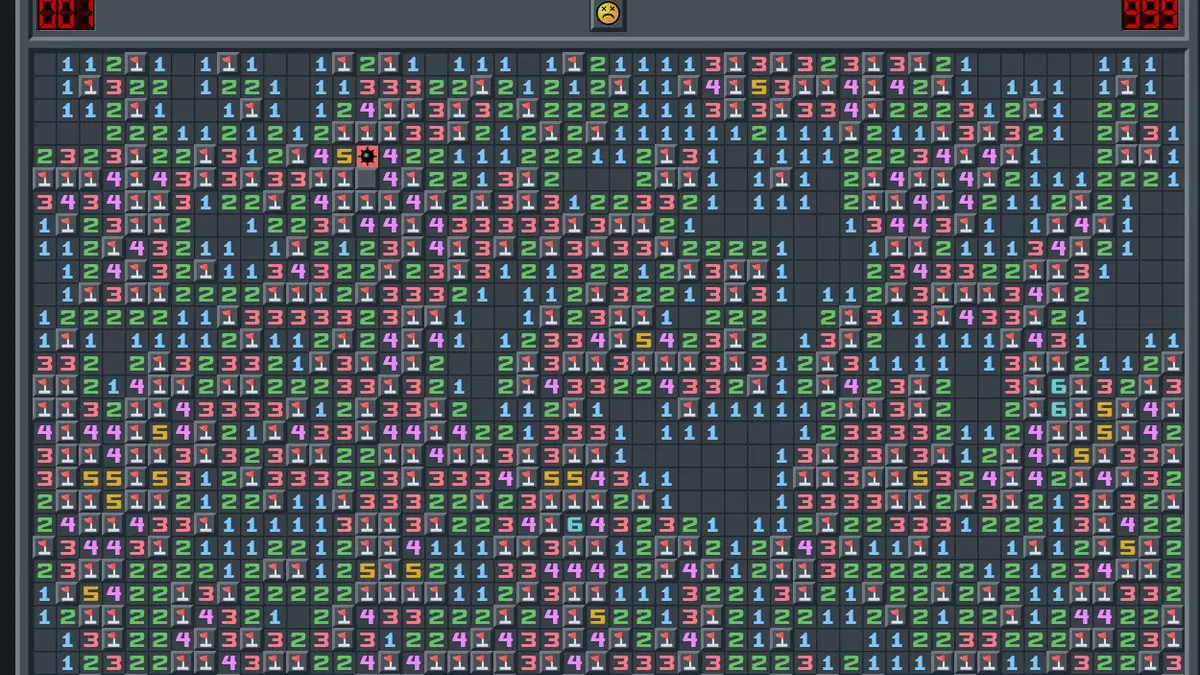
The story reads like a modern gaming tragedy. Picture this: you’re deep into a 50×50 Minesweeper grid, 650 mines scattered like digital landmines across your screen. Every click carries weight. Every number reveals a piece of the puzzle. For 50 minutes, you’ve been building toward victory, cell by careful cell.
Then the worst possible scenario appears. Two cells remain, and the numbers give you no help. Pure chance decides your fate.
“I lost Minesweeper 50×50 650 mines. I spent 50 minutes playing just on this one. Here’s the coin toss that ruins it at the end.” – u/Alternative-Ice-7534 on r/gaming
Anyone who’s played Minesweeper knows this pain. It cuts deeper than losing a boss fight or missing a jump. Those failures feel earned somehow – you can blame reflexes, strategy, or preparation. But when Minesweeper forces you to guess, it strips away the illusion of control that makes puzzle games so satisfying.
The 50×50 grid with 650 mines isn’t for casual players. This is expert territory, where mines lurk in roughly 26% of all cells. Most people stick to the standard 16×30 grid with 99 mines. Going bigger means committing to a much longer session with exponentially higher stakes.
Fifty minutes represents serious investment. That’s not a quick coffee break game – it’s a meditation on logic and patience. Every successful clear becomes a small victory. Every flag placement feels deliberate. You start seeing patterns in the chaos, finding rhythm in the methodical clicking.
Minesweeper occupies a unique space in gaming culture. It’s been part of Windows since 1992, making it arguably more universal than Mario or Tetris. Generations of office workers and students have lost hours to its simple complexity. It doesn’t need fancy graphics or compelling characters – just pure logic wrapped in digital tension.
The game’s emotional weight comes from its honesty. Unlike many modern games that use rubber-band AI or hidden assistance to smooth difficulty, Minesweeper presents raw probability. The mines are where they are. The numbers don’t lie. When you succeed, it feels earned. When you fail due to chance, it hurts precisely because everything else was skill.
This particular loss stings because it represents gaming’s oldest frustration – the moment when skill meets chance and chance wins. It’s the critical hit that kills your perfectly planned strategy. It’s the random number generator deciding your legendary drop doesn’t happen. It’s reminder that even in our digital worlds, luck still has the final say.
The Reddit post resonated because every gamer recognizes this specific flavor of defeat. We’ve all had sessions that ended not because we weren’t good enough, but because the universe decided to flip a coin. The 50-minute investment makes it worse – enough time to get emotionally invested, not quite enough to feel like the experience itself was worthwhile.
What makes Minesweeper special is how it strips gaming down to its essence. No story to distract from the mechanics. No progression system to soften failure. No teammates to blame or enemies to demonize. Just you, logic, and probability having an honest conversation about control.
The beauty lies in how players keep returning despite these crushing defeats. Tomorrow, someone will open Minesweeper and start a new grid. They’ll place their first click in the center, hoping for a big opening. They’ll methodically work through the logic, building toward that perfect clear.
And when the inevitable coin toss appears – because it always appears eventually – they’ll take their guess and hope the digital gods smile. Sometimes they will. Sometimes they won’t. That’s Minesweeper in its purest form: a reminder that even perfect logic can’t eliminate chance entirely.
The cycle continues because the potential payoff makes the risk worthwhile. Somewhere out there, another player is 45 minutes into their own expert-level grid, methodically working toward victory. When they reach their own coin toss moment, they’ll remember this Reddit post and click anyway.
Because that’s what gamers do – we play the odds, accept the losses, and queue up for the next round.