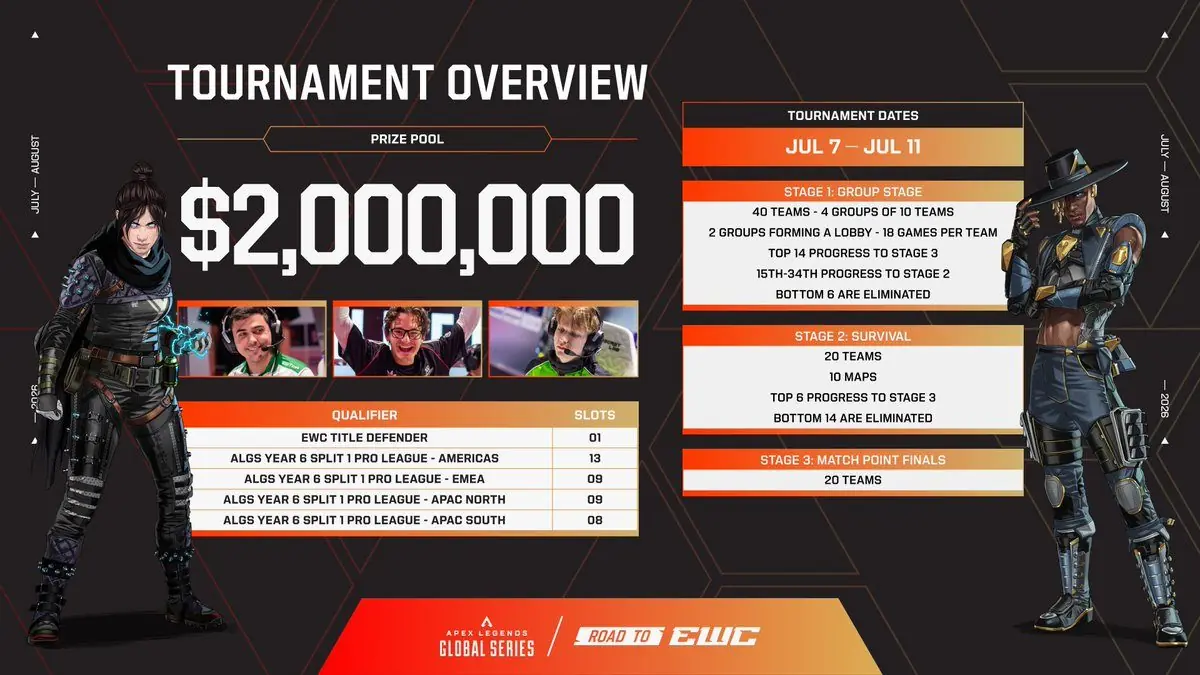
There’s something almost poetic about watching twenty squads drop from the sky, each carrying their own ambitions, strategies, and stories that will unfold across King’s Canyon or World’s Edge. In Apex Legends, every match is a narrative waiting to be written — and at EWC 26, those stories are about to reach their most dramatic chapters yet.
The Esports World Cup has never shied away from spectacle, but there’s something uniquely compelling about how they’re framing this year’s Apex Legends competition. It’s not just about the prize pool or the prestige — it’s about the artistry of competitive play elevated to its highest form.
“Rotations, reads, and relentless pace. That’s what’s expected of the best in Apex Legends at EWC 26! ⚡️” — @EWC_Extra
Those three words — rotations, reads, pace — might sound like technical jargon to casual observers, but they’re really the building blocks of modern competitive storytelling. Each rotation is a chapter, each read is character development, and that relentless pace? That’s the heartbeat driving every narrative forward.
When EWC talks about rotations, they’re speaking to something that transcends simple map movement. In the hands of elite teams, rotations become choreographed drama. There’s the early rotation that signals confidence and map control, the desperate late rotation that speaks to adaptation under pressure, and the perfectly timed third-party rotation that can rewrite an entire match’s story in seconds. These aren’t just tactical decisions — they’re authorial choices that shape how each competitive narrative unfolds.
The “reads” element adds another layer of storytelling complexity. The best Apex teams don’t just react to what’s happening; they’re constantly writing the subtext of each engagement. They read rotations like literary critics parse metaphors, understanding not just where teams are moving, but why, and what that movement reveals about their intentions, their confidence levels, and their remaining resources. It’s psychology and strategy intertwined, creating a metagame that’s as much about understanding your opponents’ stories as it is about writing your own.
And then there’s pace — perhaps the most crucial narrative element in competitive Apex. The game’s unique blend of individual skill expression and team coordination creates these incredible moments where time seems to compress and expand simultaneously. A team can spend five minutes carefully positioning and planning, only to have everything decided in a fifteen-second burst of action that feels both inevitable and shocking.
What makes EWC 26’s approach particularly fascinating is how it acknowledges that Apex Legends has evolved beyond its battle royale origins into something more sophisticated. The game has always been about survival, but at the highest competitive levels, it’s become about survival with style, survival with purpose, survival as performance art.
This tournament represents a coming-of-age moment for battle royale esports more broadly. For years, traditional esports fans questioned whether the genre’s inherent randomness and complexity could create consistently compelling competitive narratives. EWC 26’s focus on rotations, reads, and pace suggests they understand that the apparent chaos is actually where the most interesting stories emerge.
The timing feels particularly significant. Apex Legends is entering its eighth year, and the competitive scene has reached a maturity where teams aren’t just playing to win — they’re playing to create moments that will be remembered, analyzed, and celebrated long after the final ring closes. The best teams understand that they’re not just competitors; they’re storytellers working with a uniquely dynamic medium.
There’s also something culturally resonant about how EWC is positioning this tournament. In an era where traditional narratives feel increasingly fragmented, competitive gaming offers something rare: shared stories that unfold in real-time, with genuine stakes and unpredictable outcomes. When twenty squads drop into a map, they’re creating a story that none of them can control completely, but all of them help shape.
Looking ahead, EWC 26 could serve as a template for how major tournaments frame competitive battle royale. By emphasizing the narrative elements that make high-level play compelling — the strategic depth, the psychological complexity, the moment-to-moment drama — they’re helping elevate the entire competitive ecosystem.
For Apex Legends specifically, this tournament represents an opportunity to showcase how far the competitive scene has evolved. The game that once struggled to find its esports identity has become a platform for some of the most compelling competitive storytelling in gaming.
As the tournament approaches, the most intriguing question isn’t just who will win, but what stories will emerge from those rotations, reads, and relentless pace. Because in the end, that’s what great competition provides: stories worth telling, and moments worth remembering.