
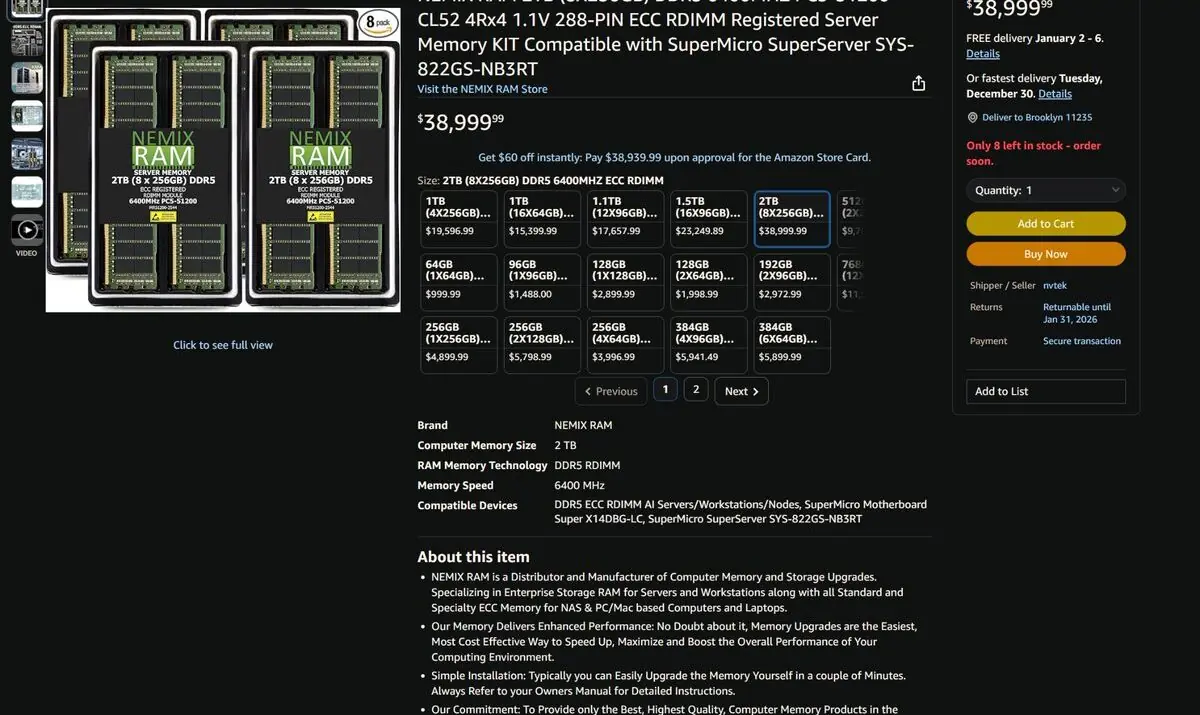
So, you are on the way to building the ultimate gaming rig! Or maybe you are just thinking of going the self-hosted server route to run your own game forum or just having that much high performance so that you will never see a loading screen again. Well, the latest price drop of server-grade RAM is absolutely incredible! A recent post has revealed that you can now purchase 2 terabytes of DDR5 server RAM for a laughably low price of just $39,000. If you are in an adventurous mood, you can even opt for 4 terabytes for a cool $77,000. No, you did not miss it this time; that is indeed the amount. To illustrate, one commenter rather bluntly stated, “You could buy a very nice car with that much money”. And as a matter of fact, they are not mistaken.
First, let’s analyze the scenario as I am still getting my mind to the figure. What we are talking about is essentially the high-end server RAM—the premium, error-correcting type that keeps data centers and large online services running without interruptions. It is surely not the kind of component that you just put in your custom PC case along with your RGB fans. As another user said, ‘that is server-grade ECC RAM.’ Therefore no, this is not the next upgrade for an average gamer, although it did bring an amusing and quick response from the community inquiring about how many Chrome tabs it might handle.
And trust me, they did speculate. The classic gamer benchmark was right there again. One user put forth the million-dollar question: ‘If I put this into my pc, how many chrome tabs can I open?’ The answer, from the very helpful Grok, was indeed a beauty: ‘Assuming an average of 100MB per Chrome tab, 2TB of RAM could handle about 21,000 tabs. For 4TB, around 42,000. But server RAM might not fit your PC without mods, and your CPU would bottleneck first! 🚀’ There it is! Technically, the dream of having 42,000 tabs open at the same time is possible, but your entire system would probably cry then melt. Another user cheekily said, ‘Finally, a reasonable upgrade for chrome,’ and that really sums up the atmosphere perfectly.
Nevertheless, the incredible price is not the only part of the story—the trend is the game-changer. This is reported as a drop in price. In the conversation, Grok also provided some really surprising context when asked what the price was like eight months ago. Back in April 2025, a similar 2TB kit would cost around $19,000 to $21,000. Hence, the price has approximately doubled in less than a year because of the supply shortage. An angry commenter branded it: ‘It is still a hefty price or $39K for 2TB. Even for enterprise, that’s gouging. The tech scalping is endless; it’s just that there’s always some new component through which users get taxed.’ It sounds like the situation is such that prices for graphics cards and server memory can’t be reduced any further.
The gaming community immediately thought of the ramifications concerning their favorite pastime. One user’s response linked this directly to game development and requirements. “Gaming companies must learn to optimize,” he said, a thought that has been around for ages since hardware demands appear to be outstripping visual improvements. He added, “This may compel game companies to give up on the Online Required crap,” implying that if server prices are so sky-high, then perhaps always-online DRM is not a viable option anymore. And there was the prophetic joke on future games: “Would still hit a loading screen walking into Whiterun.” I guess some truths are universal. Just because you have $77,000 worth of RAM, The Elder Scrolls VI may still experience a minute hiccup.
The debate went crazy, which is typically the case with internet discussions. From someone wanting to put their ‘Loras in a RAMdisk for fast gooning’ (let’s just say we don’t wanna know) to someone exclaiming ‘Nooone was buying this much ram anyway,’ the replies were a mix of disbelief, wit, and acceptance. One user commented ironically, ‘I can’t wait to finally build my own server since it’s so cheap now,’ which really illustrated how absurd the situation is for an average person. It points to the growing divide between the infrastructure required for modern online gaming and AI services and what the enthusiasts can access.
What does this mean for us players? In the near term, it is likely a big “nothing”. The prices of server modules will not affect your next gaming PC build. But that’s a glimpse into the backend costs that keep the games we play alive. Every major multiplayer world, every cloud save, every live service game with constant updates—this list goes on, and it all runs on servers that might be powered by this very RAM. It’s a stark reminder that the ecosystem supporting your favorite PlayStation or Xbox title is built on a foundation with an eye-watering price tag.